Celebrating a Saint
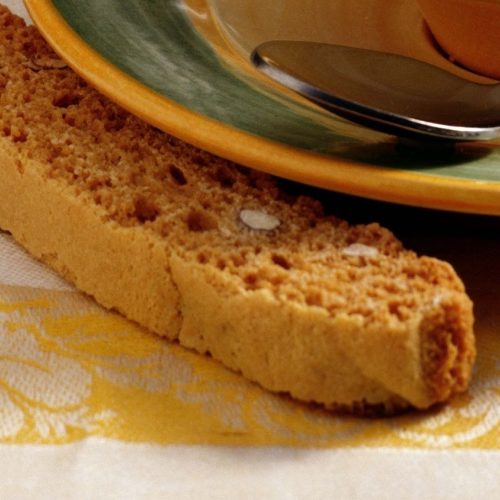
With the recipe for Biscotti.
On a blustery Friday night in February, when a nonna answers the door, three compari walk up the stairs, stopping to knock at the door on each landing as they make their way to the top floor. The family living on each tenement floor greets them, offers them anisette or wine (always accepted) or an espresso (often declined), and gives them money. They are not loan sharks or bookies coming to collect their take — they are members of a “committee” asking for donations for a springtime feast for the saint. Not a saint, but the saint— Saint Michael, Saint Anne, Our Lady of Mount Carmel, Saint Anthony, and others — the patron of their paese in the old country.
There are as many committees as there are patron saints. The men don’t expect a windfall, just small donations that allow them to carry on the tradition. Most people give only change, so when the compari receive a dollar, it’s a big deal. A prayer card serves to separate the groups of ten singles. The compari look forward to not only ordering the lights, hiring the entertainers, and assisting with the parade, but also to going out of an evening (or several) to enjoy the hospitality of their neighbors, raise some funds, and return home in a far happier mood than when they left.
The nonnas, some of whom are married to the collectors, agree that these forays into finance—even for a saint’s feast— aren’t the healthiest for the men in the neighborhood. And they scowl when their sons and daughters allow the men to enter and gather around the kitchen table. Some nonnas have been known to bar the kitchen door, either to keep their husbands at home or to prevent them from reentering when they have finished collecting.
But there comes an evening when a group, including her husband, makes it past a nonna. She offers them no refreshments as she glares across the table at her husband, who is sporting his committee pin on his worn work jacket. She makes a donation and accepts the large prayer card displaying a victorious Saint Michael driving a lance through a fallen angel. The men rise to leave, and the nonna collars her husband. She gives him a stern look and reminds him that he has to work the following day.
As they turn toward the door, a baby cries. In seconds, the new mother opens a French door separating the kitchen from the rest of the apartment. That’s all it takes. The glowing grandfather cannot resist showing off his grandson to the rest of the committee. The men ooh and aah and tell the baby that he is strong and beautiful. One of them traces a sign of the cross on the little one’s forehead.
The nonna, overcome by the fuss the men make over the baby, gets weepy. She invites them back to sit in the kitchen. She places on the table a bottle of anisette and four tiny cordial mugs with handles. She rushes to the sink to fill a machinetta with water for espresso, hesitates for a moment, then goes to the cupboard — for a box of biscotti.
She fills the four glasses and offers a toast, “To our grandson, and to Saint Michael, and to a good, big collection this year.”
Biscotti
Makes 12 slices
- 2/3 cup sugar
- 1/4 teaspoon salt
- 4 tablespoons unsalted butter plus1 tablespoon, room temperature
- 2 eggs
- 1 teaspoon vanilla
- 1/2 teaspoon almond extract
- 1/2 cup almonds, blanched, toasted
- 1 1/4 cups all-purpose, unbleached flour
- Preheat oven to 375 degrees F.
- Use 1 tablespoon butter and a sprinkling of flour to coat a loaf pan.
- Cream the remaining butter and sugar with salt, vanilla, and almond extract.
- Beat eggs into mixture.
- Mix in flour and almonds.
- Spread mixture in loaf pan.
- Bake about 25 minutes, or until a skewer inserted in the center comes out clean.
- Remove from pan; place on cooling rack.
- Slice into 12 slices.
- Place slices on buttered baking sheet; return to oven.
- Bake 6 minutes, or until bottoms of slices are golden.
- Turn slices; bake another 5 minutes, or until golden.
- Cool on wire rack.